Icey Tek Gel Bricks and Oneskin 50 Research and Testing
Author: Ian H Date Posted:18 December 2025
Disclaimer. The following article represents the views of the author (IAN) from research and testing on the road . I don't profess to be an expert, lust a very satisfied user of the Icey Tek bricks
General background
There are many types of coolers from soft sided six packs to large hard sided commercial boxes that are well over 100 litres
However they all share one feature. They rely on frozen material to keep the contents cool
This frozen material has a limited life and it and the box contents will eventually reach the ambient temperature if left long enough
The challenge is to delay the thawing process so the contents stay at a suitable temperature as long as possible
The primary tool in this regard is the quality of the box insulation which is generally very good nowadays
There are however a number of measures that the user can take to maximise the benefits of good insulation to lengthen the period it remains cold/frozen
I have read many 'ice challenge' tests over the years that I consider misleading. I am not sure how meaningful it is to have a cup full of ice and half a cooler of water after x days when you are camping or travelling
This article is intended to provide hopefully practical information based on my actual experience over many years that may help in keeping food dry and at a safe temperature for 4 to 6 days depending on outside weather and how carefully the box is managed
For want of a better word I call it the IAN system for packing food in a cooler box
Some of the information is already widely published, but I have included it for the sake of completeness
Parameters
Because there are so many box sizes and construction types I have limited this write up to quality hard sided cooler boxes between 40 and 50 litres
This is because you need at least this size to carry a reasonable amount of food and frozen material for a few days
It is also able to fit in the average family wagon and reasonable for 2 adults to lift fully loaded in most instances
The principles outlined will apply to other size boxes but would need to be scaled up or down to fit
The cooling source is based on the Icey Tek gel cooler bricks which are a unique product which allow great flexibility in terms of storage options. They are dry , long lasting and very effective.
I have used many brands of boxes with these bricks with good results. However I am now using the Icey Tek Oneskin 50 because its measurements allow for a perfect fit for the Icey Tek bricks plus it is a quality, durable box that is working very well. It also doesn't have a large footprint taking over a large area in my vehicle
This article is only about food storage, not bulk drinks. That would require a different approach
Elements of keeping food cool
The box itself
The whole cooling retention process starts with the box itself and how it is managed
A quality box will be substantial in its construction and if stored in the sun or a hot garage it will become warm and retain heat
Even house storage will mean at least ambient temperature
It is vital to remove as much heat as possible from the box before using it
If you don't ,when you put bricks and food in, the heat of the box will make the bricks thaw earlier and reduce their effectiveness
You therefore need to prechill the box
This is pretty simple. This can be a bag of ice or sundry freezer bricks/frozen juice bottles for at least 12 hrs, longer if you can
Make sure it is not just a few token items. My experience is that you would need about the equivalent volume of a bag of ice in this size box to get a satisfactory outcome.
Make sure they touch the sides as much as possible not just sitting in air
This allows for better heat transfer from the box sides
In my opinion this process is critical if you plan to be away for a few days
A weekend trip may not matter as much
It goes without saying that a cool box should never be exposed to the sun while you keep food in it
Airspace
Many manufacturers use the phrase 'air is the enemy'
This is because air is a very bad conductor of cold temperature when in a still space like a cool box
Too much air actually limits the ability to keep contents cool
This air minimisation is one of the key elements of the IAN packing system in the rest of this article
Icey Tek gel bricks
There are two sizes called 2 and 4, roughly 2 and 4 kg
In the IAN system I have converted them to volumes
The size 2 is about 2.1 L
The size 4 is about 4.6 L
This is because all coolers have a litre volume and I aim for a percentage of that volume to be frozen material in the IAN system
These litre amounts for the bricks help me work out the most effective volume for cooling on a systematic basis
(Note: Do not take as a given litre measurements for coolers that you read on the net. Measure the internal length, width and height yourself to calculate a volume figure. I have been really surprised at some of the inaccuracies I have come across in both volume and internal measurements in published material for various boxes)
Treated correctly and packed to minimise air and external heat heat transfer these Icey Tek bricks will stay very cold for a surprising amount of time and importantly keep their exact shape permanently and not reduce to a pool of water
The IAN system
I have had a lot of personal experience using these bricks successfully for many years but have never read other than general comments of using them written by others
I thought it might be useful to put my experience in writing to illustrate it is possible to keep food cool without resorting to expensive and often unnecessary technology
Of course that is easier said than done because everyone has different needs and understanding of food temperatures
I will begin with the analogy of a refrigerator to set the scene
A fridge usually has a freezer at the top , a crisper at the bottom for salad and vegetables and various levels in between including some not so cold compartments. In other words there is no single temperature to judge the fridge by
The IAN system reverses this order for a cooler. The coldest place is at the bottom and the least cold crisper type area is at the top
The cooler box therefore has different temperature layers like a fridge. The difference is that there is no fan to circulate cold air. It relies on frozen material that is in close proximity to the contents
Food needs to be loaded in that part of the box that suits its needs ie very cold at the bottom and much less cold near the lid
This is different to the traditional esky packing I have done in years gone by of bottles in one area and everything else wherever you could fit it, hoping all would be ok and not get too wet
The actual segmentation of storage layers is achieved by using various containers to separate food types placed on one another almost to the lid of the box and arranging the bricks to their best effect across the bottom and sides of the box
In combination this 'stacking' also reduces the general air component in the cooler to a minimum and as a result lengthening the cooling time than would otherwise occur for your food
More information will be provided under the packing heading following
Cooler brick ratio
In my experience somewhere between 30 and 40% gel bricks in a 40 to 50 L cooler will give satisfactory cooling for 4 to 6 days depending on pre chilling, ambient temperature and the amount of opening and closing.
This sounds like a lot of caveats but it is no different to how eskies have always needed to be managed. It just gives better outcomes now because of better insulation combined with the Icey Tek bricks long life
Obviously 40 % or more would be better than 30% but in the end compromises have to be made to allow for box and brick shapes plus the food carried and time needed to stay cool
Small spaces can be filled with frozen juice bottles or even lunchbox bricks to improve the ratio of frozen material
I currently use 2 size 4 and 3 size 2 bricks plus a frozen juice bottle in my Icey Tek 50 Oneskin
This is about 17 L in a 46 L box or 37% of the box taken up by frozen material that fits exactly from edge to edge of the cooler
We get up to 5 days in hot weather with that cooling ratio maintaining food safe temperatures all the risk foods like milk,yogurt meat and salad
Cooler brick placement
I stack the two size 4 bricks flat on top of each other at one end. of the box. On top of them I put 2 size 2 bricks vertically and at right angles around the edges
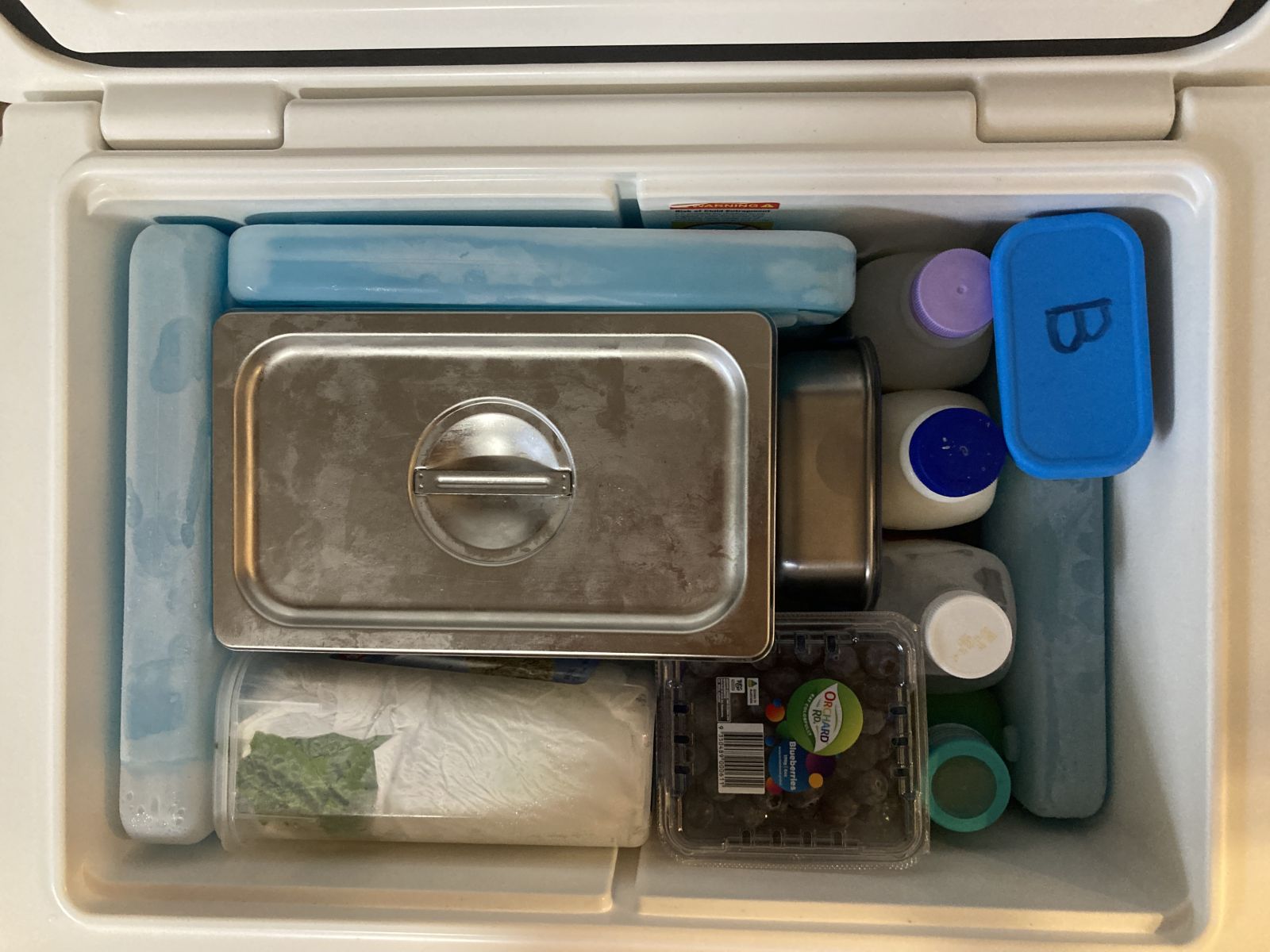
At the other end I put a size 2 vertically across the box. (see photo)
I consider the bricks being flat on the bottom to be an essential starting point for the food cooling process
I put a frozen juice bottle between the milk and other bottles to help keep them cool
The logic of this placement is to maximise the frozen surfaces available for food containers to touch to help them stay cool
Packing
This is a very subjective process because of the different foods people take and how they use the box
I will start with what we do because I have no other benchmark
Firstly I have bought a number of stainless steel containers with lids. (photo attached)
Stainless conducts the cold very well and is easy to clean
The core containers are what are called Gastronorm pans
They are the ones you see in a sandwich shop with the lettuce and tomato etc in
They come in a myriad of sizes at very reasonable prices from catering supply shops
Google will help you find them and all their various sizes
I use the 1/4 size which is 100 mm deep. I have 2 to stack on one another
One good thing about them is that the lids lift off rather than needing to be unclipped
I highly recommend them
I also have one plastic container for salad. Cold stainless ruined our lettuce in an early trial
It sits on top away from all direct cold surfaces
Other sizes and shapes of container can be found in places like IKEA Officeworks and Coles/Woolies etc
I find for the more sizeable containers 75 to 100 mm deep are very useful for a lot of things
An attached photo shows some of the variety of containers I use depending on what we take away
For the metal containers and milk/juice/jam bottles I make sure that at least one side is in direct contact with an Icey Tek brick, sometimes two
By doing this it maximises cooling in each container with very limited loss through air and displaces much of the air volume in the box
This dense packing also serves the purpose of shielding the bottom bricks from thawing quickly
The very bottom brick is usually still largely frozen after 4 or 5 days when we unpack after a trip
The basis for doing this style of packing is because it is the best way to transmit cold ie via a direct interface, not just sitting in an air pocket
if you empty a container or bottle put the empty container back or replace with the same item from a shop fridge, again to keep the general air to a minimum
I have found that if you leave the lid off a container the temperature of the surface of that container rises by a couple of degrees. This is probably because the small cool air pocket that was in the closed containers is diluted by the greater mass of all the spare air space in the box. My advice is to leave lids on
For milk we only use 1 L containers. It is easier to keep cool than 2 L. We actually have 2 one litre containers at once in the box
Finally and very importantly pack all your containers the night before and put them in the fridge. When you transfer them to your cooler box the next day the container, the food and the air in them will be chilled and ready to go and not an immediate drain on the bricks in your box
Food storage comments
How you pack the box for your personal taste is an interesting challenge, a bit like rubik's cube
We have found the stainless container sitting fully flat on the brick at the bottom can still be less than 2 degrees on the metal surface after 4 or 5 days
All other containers for cheese, milk , yogurt and have also kept at or below food safe temperatures of 5 or below at 4 or 5 day mark, often longer provided they touch a brick on one of their faces (except the salad)
The salad ingredients are usually a few degrees more but is probably similar to the temperature in a fruit shop
In the plastic salad container we wrap the salad in paper towelling for the whole time to help it keep better over time
Of course you may wish to take packets of frozen cryovac meat or frozen meals in the stack either in a container or loose
We have found that frozen meals touching the bottom brick are still 75% frozen on the second night .
It is really about personal trial and error but I have several small digital thermometers that I use to check what is going on so I am fairly comfortable with the above outcomes the way we pack the box
However as you can see from the photo of the unpacked box there is quite an extensive area to work with
You can also use the Icey Tek poly drop in tray above the 2 large bricks and swing the side vertical brick to the end of the box . The tray is very good for things like tomatoes, fruit or chocolate that don't need to be very cold. The area below could be for bulk frozen food
I am sure there are plenty of other ideas out there for using these bricks because you don't have to deal with water
Final comment
There is more detail I could go into but I think this is enough at the moment to give anyone interested a feel for how to have a successful camping trip with your food being suitably stored with Icey Tek gel bricks
The above IAN system information is from my own research and actual travel experience over several years plus advice from my wife about food hygiene to complete the package
Thank you for reading
Ian